Dear Granny,
I can already hear your voice—that sharp intake of breath, the way you’d purse your lips before launching into one of your lectures about propriety. “Tattoos are not for us, David. They’re for them.” Always “them,” that shadowy group of people I was supposed to avoid becoming at all costs. But as I lay in that tattoo chair for over five hours, needles buzzing against my skin, I didn’t think about “them” at all. I only thought of you.
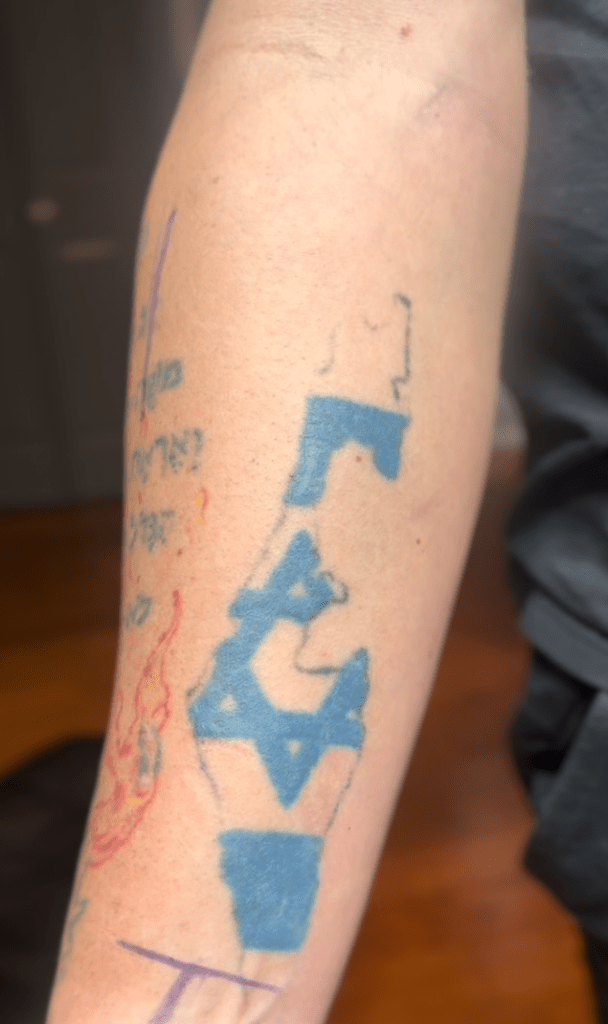
The tattoo on my inner arm had been a prison for fifteen years. Every morning when I’d catch it in the mirror—that bright blue Star of David screaming from my forearm, the borders of Israel etched in permanent reminder—I’d feel the weight of who I used to be pressing down on my chest like a stone. When my wife approached me that day, her voice gentle but firm, I knew she was right. “It’s time, David. It’s time to cover it.” She didn’t need to explain why. We both knew that particular piece of ink had become a roadblock, not a reminder.
To understand why requires me to take you back to 2010, when my mind began to fracture like ice cracking under spring sun. The schizophrenia was taking hold—voices started as whispers, background noise I could ignore while going about my days. But they grew bolder, more insistent, until they were shouting instructions I felt compelled to follow. The bipolar mania had me locked in a cycle of sleepless nights and manic energy, my thoughts racing faster than I could process them.
You are Moses reborn. You must restore Judaic law to the land.
I can still taste those chain-smoke nights on our back deck, riding the manic wave that kept me wired for days at a time. The bitter coffee grew cold as I sat hunched over religious texts, convinced I was receiving divine revelation while my mind spiraled deeper into delusion. Cars rolled by on the street below, their headlights cutting through the darkness as sunset became sunrise and I remained frozen in place, hardly sleeping or eating, watching the world move while my dual diagnosis—schizophrenia and bipolar disorder—pulled me further from reality. Inside my skull, delusions crystallized into certainty with each passing cigarette, the mania feeding the psychosis until I couldn’t tell where one ended and the other began.
When my wife and the kids returned from their week of respite at Wallowa Lake, I watched her face crumble as she took in my transformed arms. Hebrew scriptures snaked from elbow to wrist, flames licked upward from my skin, and there—blazing like a beacon of my madness—was Israel mapped in permanent ink. “David, what have you done?” Her voice barely a whisper, but it echoed in my ears like a scream.
Three years later, by 2013, the fog had lifted. The voices fell silent. The visions faded. Whatever divine intervention had occurred, the schizophrenia released its grip and never returned. But the tattoos remained, permanent reminders of my descent into darkness. Therapy became my daily practice—unpacking decades of trauma, learning to distinguish between divine inspiration and mental illness, rebuilding relationships I’d damaged during my unraveling. The tattoos served as both motivation and torment, proof that I’d survived but also evidence of how far I’d fallen.
This tension between shame and survival followed me everywhere, but nowhere more intensely than in Cuba in December 2015. The heat pressed against my long sleeves like a furnace, sweat pooling at my collar as we moved from church to church, ministry to ministry. At 95 degrees with humidity that made the air feel solid, I must have looked ridiculous—the only person in Havana wearing long sleeves. The pastor had been watching me for days, his eyes following my covered arms with curiosity rather than suspicion. When he finally approached through our translator, his question was simple: “Why do you wear long sleeves in my country? You must be exhausted?”
My hands trembled as I rolled up my sleeves, revealing the Hebrew text, the flames, the star. I felt naked, exposed, like a fraud discovered in the middle of his con. This was it—the moment he’d see me as one of “them,” the people you’d always warned me against becoming. Instead, he leaned closer, studied the ink with artist’s eyes, and asked about their history. I told him everything—the delusions, the madness, the shame. He listened without judgment, then took a deep breath I was sure would be followed by condemnation.
“Son,” he said, looking directly into my soul, “these stand as a reminder of who you were. They do not define who you are. Never let them be anything more than a reminder of the miracle of whom you have become today. A good man. A kind man. A man after His own heart.”
Those words transformed everything. I stopped hiding my arms, stopped covering my past. The tattoos became conversation starters, doorways into discussions about pain, trauma, healing, and redemption. People would see the Hebrew, the flames, the star, and their eyes would shift—sometimes with curiosity, sometimes with judgment—but always with questions. “What do they mean?” they’d ask, and I’d tell them about the lowest point of my life, about divine healing, about the choice we all have to become something different than what we were. My scars became my ministry.
But one tattoo always remained problematic. That map of Israel on my inner arm was different from the others. While the Hebrew scriptures and flames told a story of personal struggle and divine encounter, the borders of Israel told a story I’d never intended to tell. Jews criticized the boundary lines (apparently I’d omitted Gaza and the West Bank). Arabs saw it as a political statement. Americans brought their own complex feelings about Middle Eastern politics. This wasn’t about my past anymore—it was about other people’s present conflicts. Instead of opening doors for ministry, it was slamming them shut.
So when I arrived at my consultation, I brought a collection of half-formed Christian imagery—lions representing Judah, doves symbolizing peace, crosses on hilltops crowned with thorns. Safe, predictable, sanitized. My artist, a master of realism with a thick Slovak accent, looked at my sketches and shook his head. “No, I will not do these. Not because they are Christian, but because they are not you. I will not create a tattoo that we both cannot walk away from feeling is a true piece of art from the soul.”
Panic set in. What if I couldn’t find the right image? What if I was stuck with Israel’s borders forever? Then I thought of you. I thought of my bride, who’d walked through hell with me and somehow found the strength to believe in my potential even when I couldn’t see it myself. I thought of my children, who’d loved me with their whole hearts even when I was the distant father I’d sworn I’d never become. I thought of guardian angels.
“What about a guardian angel?” I asked.
His face lit up. “Yes, we will find. This is the right idea.”
We scrolled through images of classical art—Renaissance paintings, baroque sculptures, museum pieces that had captured the essence of divine protection for centuries. When we found the one, I knew immediately. She was beautiful without being sentimental, powerful without being intimidating, classical enough to honor your Catholic faith, meaningful enough to represent the guardians who’d guided me through darkness into light.
Five hours later, the first session was complete. Where Israel’s borders had once proclaimed my political confusion, a guardian angel now watched over my arm. Her hair swept gracefully across my skin, her face serene but alert, her presence a daily reminder of the angels God had placed in my life. You, Granny, who believed in me from the start and loved me to your end. My dear wife, who saw my potential even when I was broken. My children, who gave me their hearts even when I was distant. The Cuban pastor who taught me that scars could be testimony.
Every morning when I see her in the mirror, I think of you. After decades of blocking out your memory because I wasn’t ready to deal with losing you—the one purely positive thing from my childhood—I now get to look at my arm daily and remember: I am loved. I am guided. I am not alone. The tattoo represents new life, new identity, new purpose. I am still one of “them,” Granny, but I wear that badge not with shame but with honor. I get to live a life of peace, helping others skim off more of their past so they can walk lighter in the present.
This guardian angel is for you, for my loving wife, for my children, for everyone who refused to give up on me when I’d given up on myself. She’s a reminder that redemption is possible, that our lowest moments can become our greatest ministries, that the very things we’re most ashamed of can become the things God uses most powerfully.
I know it wouldn’t have been your first choice, Gran, but I know as an artist yourself, you would have appreciated the beauty of his workmanship, the passion displayed not on paper but on skin, the meaning and purpose made visible to the world.
Thank you for always being there for me. For loving me. For being hard on me when I needed it. Thank you for the life lessons, for always pushing me to take the left turn instead of the perilous right. Even though it took me 31 years to deal with losing you, I now get to look at my arm daily and see you there—my dearest Granny, my guardian angel in disguise.
Love you, Gran. Wish you could have been here to see this one.
Miss you so,
DW

 Letters To My Granny
Leave a comment